For years, organisations have invested in learning platforms, course libraries and online training.
But a bigger question is emerging:
Are we really building capability – or simply giving people access to content?
In a workplace where technology is changing rapidly, AI is reshaping jobs and collaboration increasingly crosses languages, markets and cultures, having access to learning is no longer enough.
People need to know more, do more, communicate better and apply knowledge with confidence.
This is where the combination of Skillsoft, Busuu and Easygenerator creates an interesting opportunity.
Three strengths. One Learning Ecosystem.
Each platform brings something different to the learning equation.
Skillsoft provides the breadth and depth of external expertise – from technology, digital skills and AI to leadership, business and professional development. It gives employees access to the knowledge and skills they need to remain relevant in a changing world.
Busuu adds something equally important: the ability to communicate. Language skills can influence collaboration, customer relationships, leadership and confidence. Knowledge becomes far more valuable when people can communicate and apply it effectively.
Easygenerator brings the organisation’s own knowledge into the picture.
Every business has valuable expertise that doesn’t necessarily exist in a traditional course catalogue – its processes, products, systems, customer knowledge, lessons learned and best practices.
Easygenerator makes it possible to capture that knowledge and turn it into practical learning that belongs to the organisation itself.
And when these three capabilities come together, something much more powerful emerges.
Learn. Communicate. Apply.
An employee might use Skillsoft to develop a new digital or leadership capability.
They might use Busuu to strengthen the language and communication skills required to collaborate with colleagues, customers or international teams.
They can then access organisation-specific learning through Easygenerator to understand how that capability applies within their own business.
The result is a learning journey that connects external knowledge with internal expertise and human communication.
That is a significant shift.
Moving Beyond the Course Catalogue.
Traditional L&D can sometimes be measured by activity:
- How many courses were completed?
- How many people logged in?
- How many hours of learning took place?
But the real value of learning is not measured by consumption.
It is measured by capability.
- Can employees perform better?
- Can they adapt to new technologies?
- Can they communicate more effectively?
- Can they solve problems?
- Can they transfer knowledge to others?
- Can the organisation retain and share the expertise it has built?
These are the questions that matter.
Building Capability From Three Directions.
The real strength of this ecosystem is that learning can come from three complementary sources:
1. The world outside the organisation
New technologies, emerging skills, leadership thinking, business practices and professional expertise.
2. The people within the organisation
Products, processes, systems, experience, customer knowledge and organisational know-how.
3. The individual employee
Their ability to learn, communicate, apply knowledge and continue developing.
Bringing these together creates a continuous learning loop:
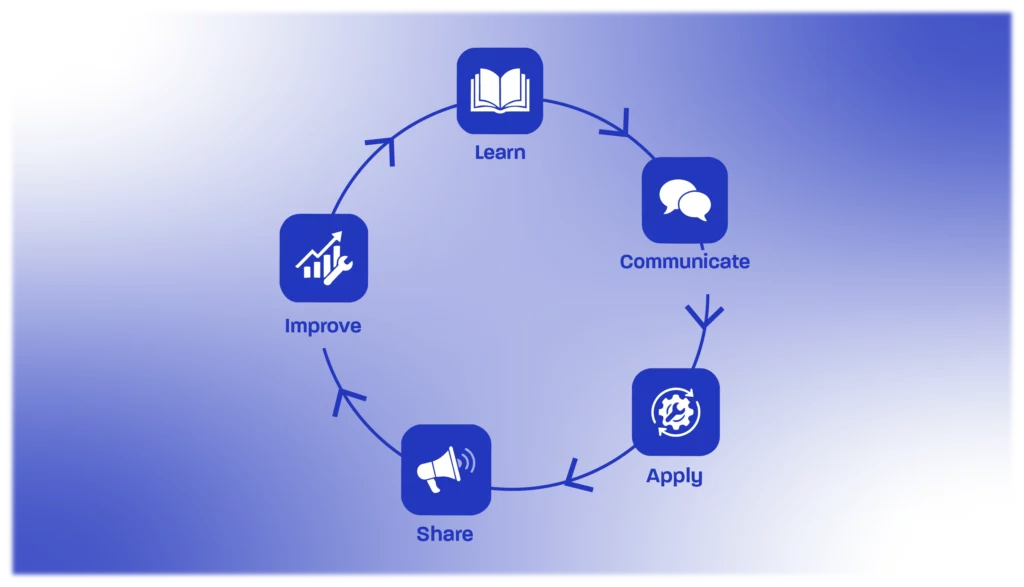
And that loop can become part of how an organisation develops its people – rather than simply another training initiative.
The Future of L&D is Capability Building.
The conversation around learning and development is changing.
It is moving from: “What courses should we offer?”
to: “What capabilities does our organisation need – and how do we build them?”
That is a much more strategic question.
Skillsoft, Busuu and Easygenerator can each play a distinct role in answering it – bringing together world-class learning, language confidence and organisational knowledge in a way that is practical, relevant and connected to the needs of the business.
Because ultimately, the goal of L&D isn’t to create employees who have completed more courses.
It is to create people who are more capable, more confident and better equipped to contribute.
And that is the difference between delivering learning and building organisational capability.